Many people start researching diastema treatment for a gap between their front teeth, then hesitate.
That’s often because of accounts describing the gap reopening even after braces closed it.
But moving teeth to close a gap
and addressing why the gap formed in the first place are two different problems.
Depending on whether gum disease or a bite issue is the cause,
the treatment order and outlook change completely.
The treatment order for diastema depends on its cause.
If gum disease is the cause, gum treatment comes first; if a bite issue is the cause, moving the lower teeth as well may help reduce relapse.
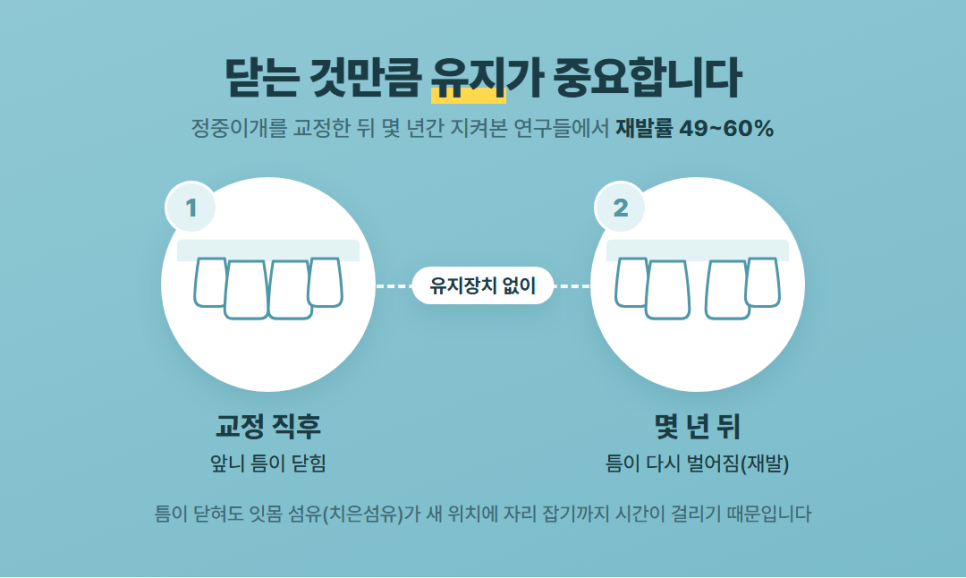
Some studies report a relapse rate as high as 49% after treatment, which is why retainer care matters so much.
What Are the 6 Diastema Causes of a Front Teeth Gap?
The short answer: there are six main diastema causes, so identifying the cause is always the starting point for treatment.
A diastema is a gap between the two upper front teeth.
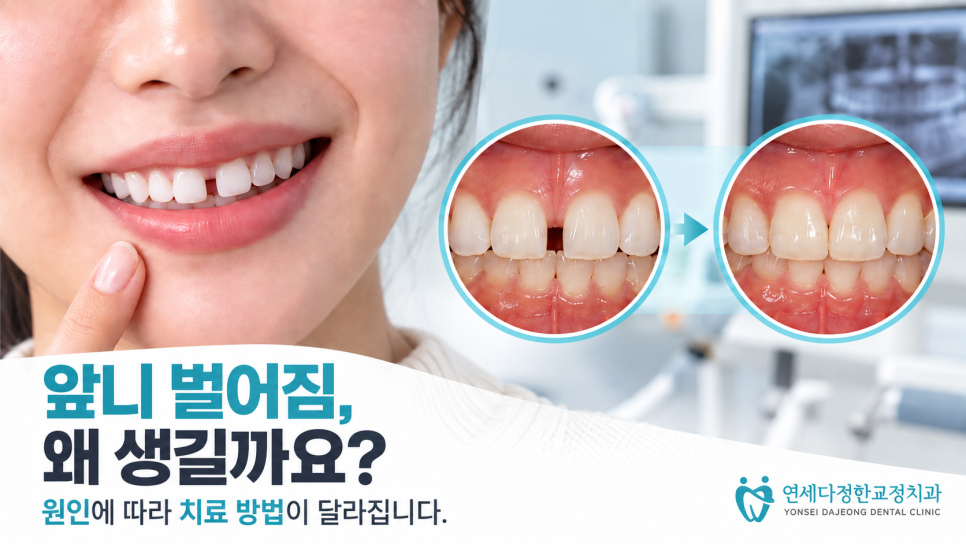
The most common diastema causes are:
- Small teeth (microdontia)
- Congenitally missing permanent teeth
- A hidden extra tooth (supernumerary tooth) in the bone
- A thick labial frenum (the tissue band inside the upper lip)
- A tongue-thrusting habit against the front teeth
- Gum disease (periodontal disease)

In adult patients, though,
a bite (occlusion) problem is especially often the cause.
If the lower teeth sit too far forward and keep pushing the upper front teeth outward,
closing just the upper front teeth tends to let the gap reopen.
In these cases, moving the lower teeth back as well may help the gap stay closed.
If Gum Disease Is One of the Diastema Causes, How Does Treatment Work?
If periodontal disease is the cause, gum treatment comes first and orthodontic treatment follows.
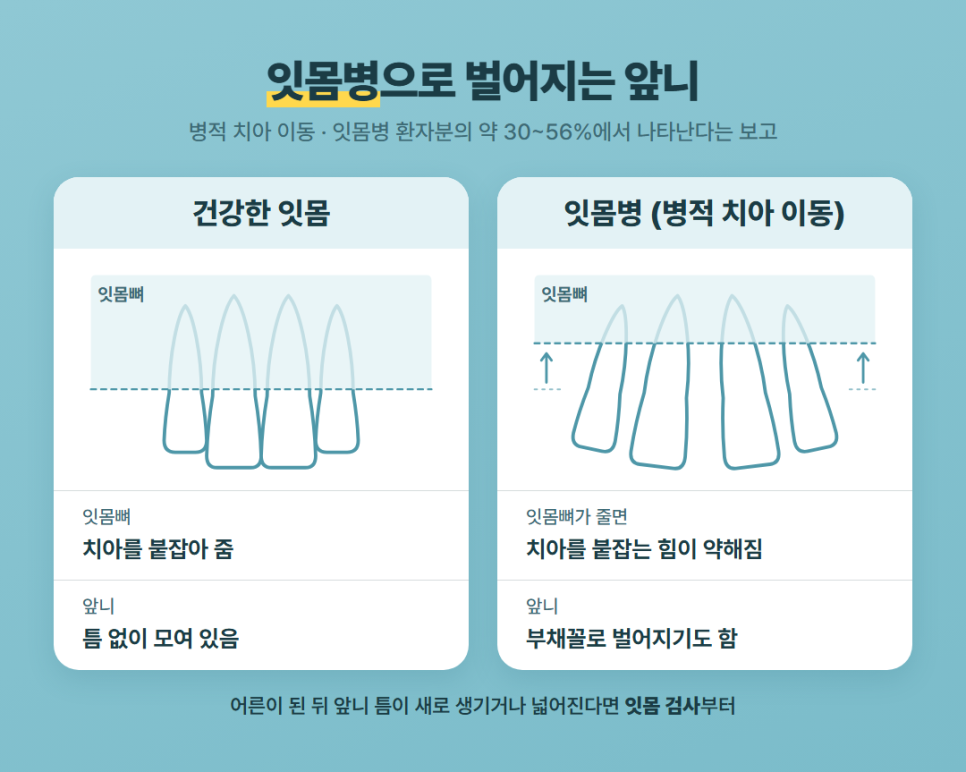
Pathologic tooth migration is when weakened support from bone loss lets the front teeth fan outward.
Pathologic tooth migration becomes more common as periodontitis severity increases.
One study observed it in about 51% of patients with severe periodontitis and about 50% of those with aggressive periodontitis.
“Pathologic tooth migration is relatively common among patients with periodontal disease, and its frequency increases with disease severity.”
This finding comes from a 2016 paper by Khorshidi and colleagues at Shiraz University, published in the Journal of International Society of Preventive and Community Dentistry.
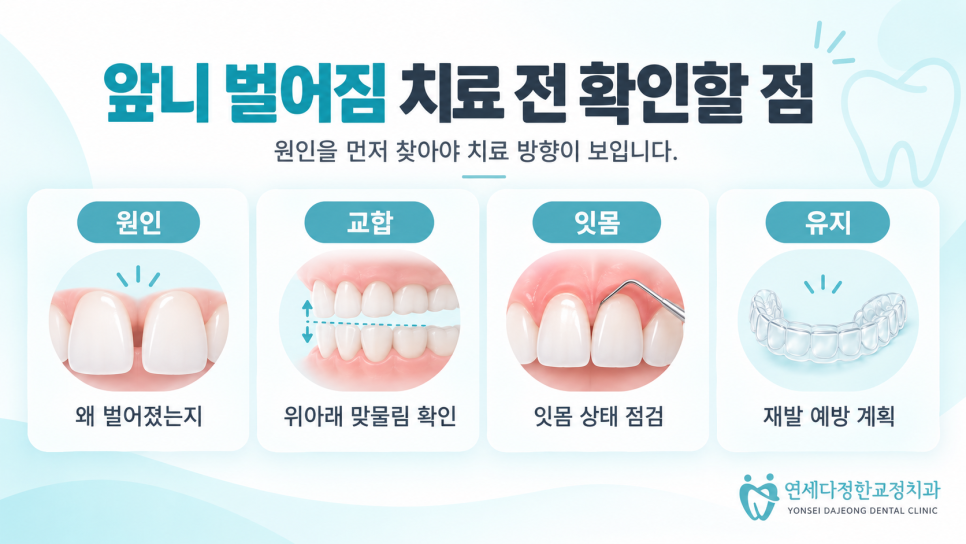
So if a gap between your front teeth appears or widens after adulthood,
a gum exam should come before orthodontic treatment.
✅ A front teeth gap appeared after adulthood
✅ The gap has been widening over time
✅ Gums bleed frequently while brushing
✅ Teeth feel loose
Moving teeth while inflammation is still present can make gum disease worse.
Teeth with reduced gum support bear more strain even under the same force, so inflammation needs to be brought under control first, and orthodontic movement should then proceed carefully with lighter force.
Cheongnyangni Yonsei Dajeonghan Orthodontic Clinic has orthodontists, periodontists, and comprehensive dentistry specialists working together,
so gum treatment and orthodontic care can continue seamlessly in one place.
How Is Orthodontic Treatment Different from Resin Bonding or Veneers?
The biggest difference is how the gap gets filled.
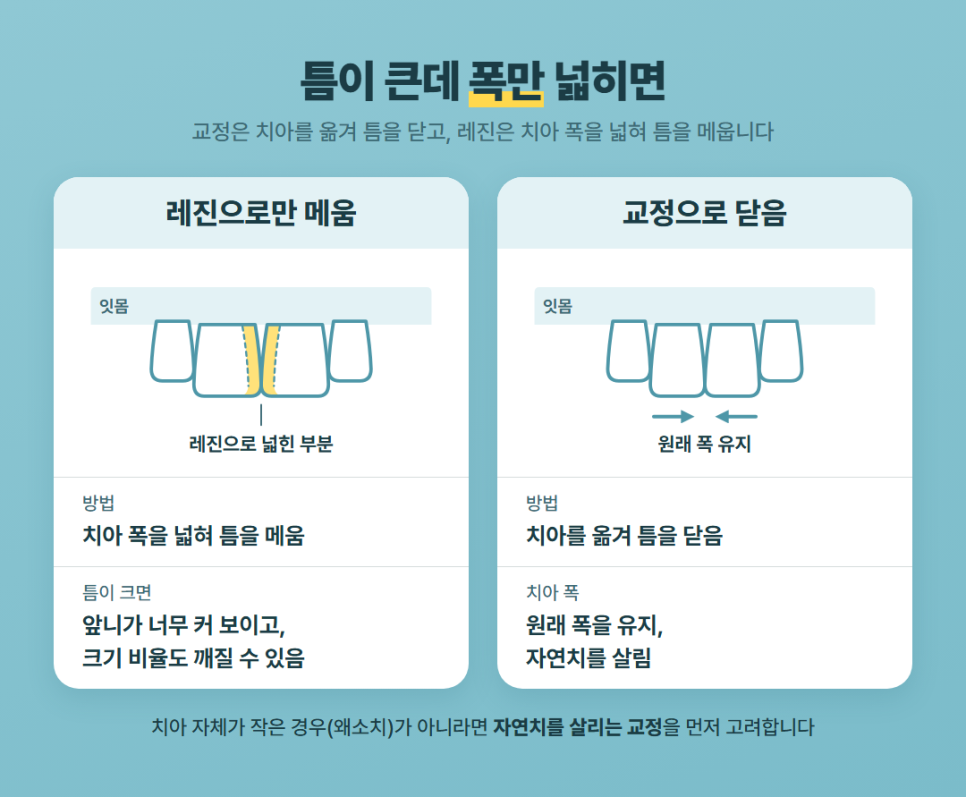
Braces move the teeth to close the gap, while resin bonding and veneers widen the teeth to fill it.
| Category | Braces | Resin Bonding | Veneers |
|---|---|---|---|
| Tooth Reduction | None | Minimal | Thin layer removed from front surface |
| Duration | Varies by cause and extent | Usually one visit | Requires a fabrication process |
| Things to Watch For | Possible relapse (retainer required) | Discoloration, surface roughening | Chipping; higher risk with teeth grinding |
| Typically Used For | Large or multiple gaps, bite-related causes | Gaps from small teeth | Gaps from small teeth |
If the gap is large, though, simply widening the teeth can make the front teeth look unnaturally big
and throw off the tooth size ratio (Bolton ratio).
So unless the teeth themselves are genuinely small, as with microdontia,
orthodontic treatment that preserves the natural teeth is generally considered first.
Also, having a gap only in the upper front teeth doesn’t mean only the upper arch can be treated.
If the lower front teeth are pushing from behind, moving the lower arch as well may help the gap stay closed.
Can a Gap Closed by Braces Reopen?
Yes — a closed front teeth gap relapses relatively often, which is why retainer care matters.
Relapse refers to a gap that was closed with braces reopening after treatment.
In a study that followed patients for several years after diastema correction,
the relapse rate was reported at 49% in one case.
Even after the gap closes, the gum fibers (gingival fibers) take time to settle into their new position.
Fixed (wire bonded behind the front teeth): stays attached 24/7 unless it comes loose
Removable (clear/transparent type): wear time is self-managed; watch for loss or damage
receives both a fixed and a removable retainer.
If your fixed retainer comes loose, please come in right away rather than waiting.
A front teeth gap is a question of ‘why did it form’ before it’s a question of ‘how do I fill it.’
Closing a front teeth gap is sometimes associated with greater comfort when smiling in social situations,
though this is not a guaranteed outcome.
Outcomes can vary depending on the cause and individual condition.
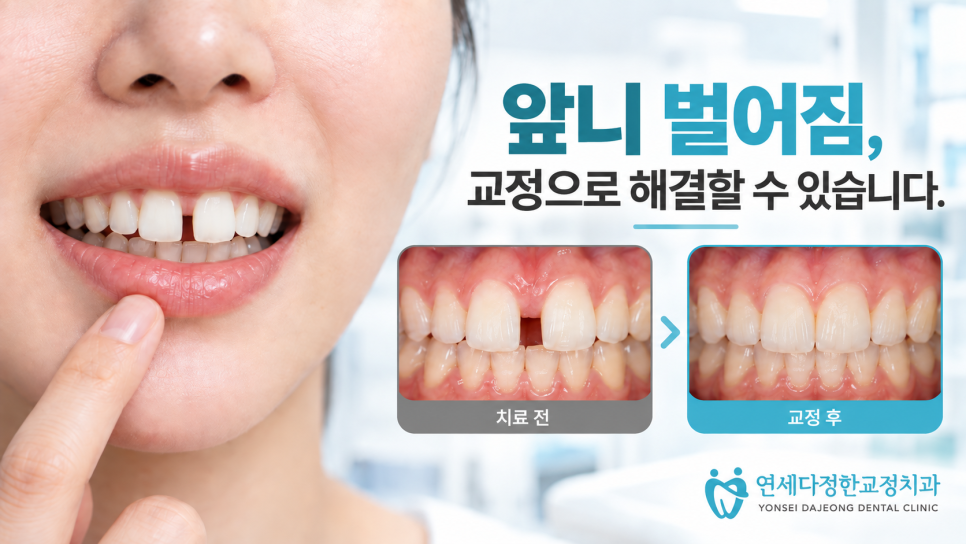
If you’re considering diastema treatment in the Dongdaemun area,
we recommend diagnosing the diastema causes before deciding on a treatment method.
The clinic is a 5-minute walk from Exit 3 of Cheongnyangni Station, and also easily reached from Dapsimni and Jeonnong-dong.
You can find detailed treatment information on the Cheongnyangni Yonsei Dajeonghan Orthodontic Clinic website.
Frequently Asked Questions
1. My child has a gap between their front teeth — do they need braces right away?
In most cases, it’s fine to simply watch and wait. This is a common, often temporary stage around age 6; one survey found that the proportion of children with a front teeth gap dropped from about 65% at age 6 to about 14% by age 12, once the canine teeth come in. That said, an unusually large gap can sometimes signal a hidden extra tooth or a missing tooth, so an orthodontic checkup around age 7 is recommended.
2. How long does gap teeth treatment take in the Dongdaemun area?
It depends on the cause and extent of the gap. In some cases, closing the space alone took 9 months, with another 3-4 months for retention. Overall treatment time typically ranges from about 1 year on the shorter end to 2-3 years on the longer end.
3. I was told I need an implant — can braces replace it?
That’s a decision best made after a detailed diagnosis. Even when an implant is ultimately needed, closing the space with braces first may contribute to a better outcome in some cases. For patients who are still growing, implants are generally placed only after growth is complete, with timing typically determined through growth-plate analysis around the sophomore or junior year of high school.
4. Can a front teeth gap be fixed with just resin bonding or veneers instead of braces?
If the gap is simply due to naturally small teeth, that can work. But if the gap is large or caused by a bite issue, widening the teeth alone can leave the proportions looking off or leave a risk of relapse, so it’s safer to consider braces as well.
References
· Khorshidi H, Moaddeli MR, Golkari A, et al., 「The prevalence of pathologic tooth migration with respect to the severity of periodontitis」, Journal of International Society of Preventive and Community Dentistry, 2016. View source
· Shashua D, Artun J, 「Relapse after orthodontic correction of maxillary median diastema: a follow-up evaluation of consecutive cases」, The Angle Orthodontist, 1999. View source
· Liu JF, Hsu CL, Chen HL, 「Prevalence of developmental maxillary midline diastema in Taiwanese children」, Journal of Dental Sciences, 2013. View source
This article is intended for general health information purposes only and is not a substitute for individual diagnosis or treatment.
If you have symptoms, please consult a specialist.