There’s one question orthodontic consultations hear more than any other.
Do I really need to have a tooth pulled?
Consultations for crooked canine tooth correction in Cheongnyangni often start with this same question.
But the answer isn’t as simple as it might seem.
When the canine tooth is only mildly out of place, it can often be straightened without extraction. When it’s severely displaced or the mouth protrudes as well, a small premolar is often removed instead.
Whether treatment for a crooked canine tooth in Cheongnyangni involves extraction or not depends on the severity of the misalignment and whether the mouth protrudes.
Mild cases can often be corrected with non-extraction methods such as arch expansion, interproximal reduction (IPR), or moving the molars back.
Severe cases often involve removing four small premolars and using that space to align the teeth, with treatment typically taking 1 to 3 years.
Why Do Canine Teeth Become Crooked?
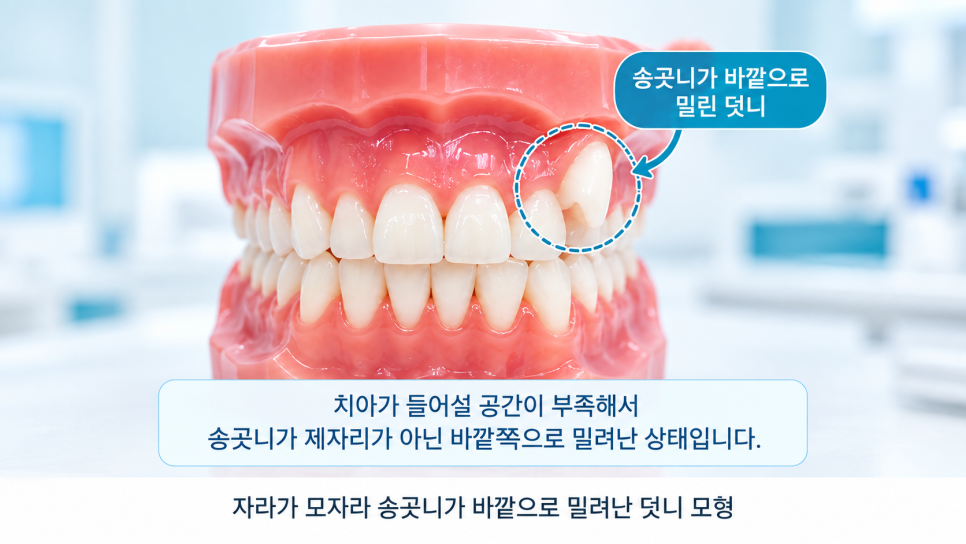
To put it simply, a crooked canine tooth is a tooth that erupts out of alignment or outside its proper position because there isn’t enough space for it.
It usually happens when there’s a mismatch between jaw size and tooth size.
The reason this shows up at the canine teeth in particular also has to do with eruption order.
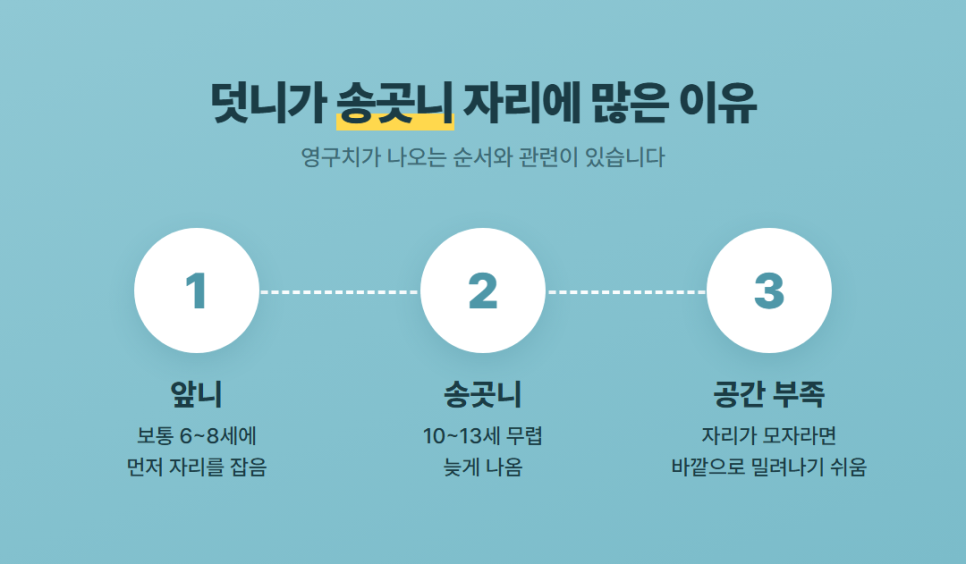
Front teeth usually come in around ages 6 to 8, while canines erupt later, around ages 10 to 13.
Since the front teeth settle into place first, canines that come in later tend to get pushed outward if there isn’t enough room left for them.
For this reason, the Korean Association of Orthodontists (KAO) recommends that children have their first orthodontic checkup around age 7, when the front teeth are replaced by permanent teeth.
The Korean Association of Orthodontists advises that children undergo their first orthodontic evaluation around age 7.
This is guidance from the Korean Association of Orthodontists.
This checkup isn’t meant to start treatment right away — it’s an early check to see whether the teeth are coming in in the right order.
What Happens If a Crooked Canine Tooth Is Left Untreated?
Left untreated, it can make cavities and gum disease more likely.
That’s because a toothbrush can’t easily reach the spots where teeth overlap.
· Bristles and floss have a harder time reaching between overlapping teeth, which raises the risk of cavities.
· Correcting a crooked canine tooth may improve chewing efficiency.
Wiping behind a crooked canine tooth with gauze can reveal more plaque buildup than in other areas of the mouth.

If floss consistently catches or your toothbrush can’t reach a certain spot when you brush, it’s worth getting a checkup.
Does Crooked Canine Tooth Correction in Cheongnyangni Always Require Extraction?
Not necessarily.
Whether extraction is needed is decided after evaluating the severity of the crooked tooth, whether the mouth protrudes, and the facial profile together.
When the displacement is severe, four small premolars are typically removed, and that space is used to align the teeth.
The gaps left behind are generally closed by the end of treatment.
For mild cases, non-extraction methods that straighten teeth without removing any are usually considered first.
| Method | How It Works | Best For |
|---|---|---|
| Arch expansion | Widens the dental arch to create space | Crowding caused by a narrow jaw |
| Interproximal reduction (IPR) | Shaves a thin layer of enamel between teeth to create space | Mild crowding |
| Molar distalization (moving molars back) | Moves molars backward to free up space in front | Cases with a slight space shortage in front |
| Extraction orthodontics | Uses space from removing 4 premolars | Severe crowding or cases with mouth protrusion |

· There’s no official guideline confirming a single rule like “extraction is required once the space deficit exceeds a certain number of millimeters.”
· The decision considers not just how much space is missing, but also mouth protrusion and facial profile.
Can Clear Aligners Also Straighten a Crooked Canine Tooth?
For mild crowding, clear aligners can be an option.
However, they have limitations when the crowding is severe or when teeth need complex movement.
A 2024 international systematic review compared treatment duration between clear aligners and fixed braces for mild-to-moderate crowding.
Pooling 10 studies, it found no clear difference in treatment duration between the two appliance types.
That said, in one of the included studies, clear aligners averaged 8.4 months versus 12.1 months for fixed braces — a difference of about 3.7 months.
The overall certainty of evidence was rated as low.
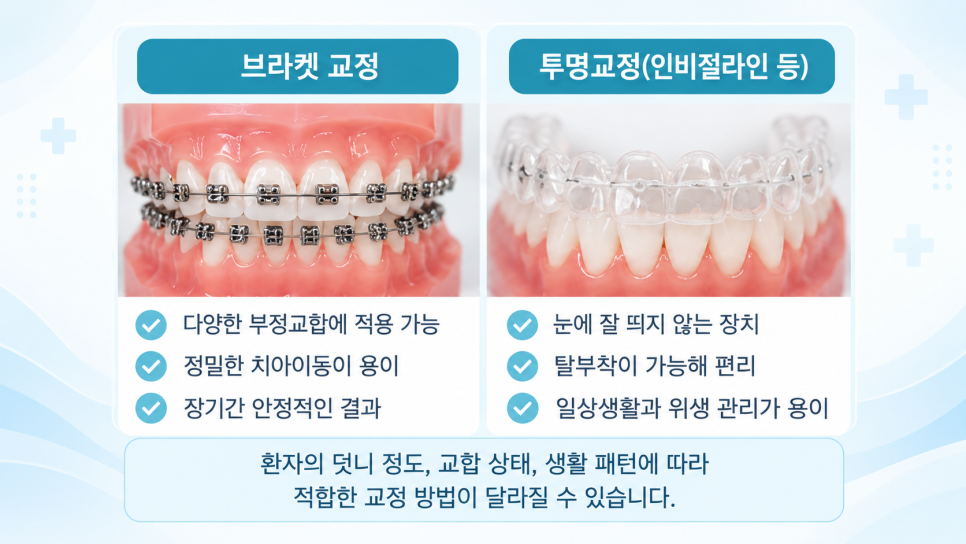
On the other hand, a 2016 paper in a Korean dental journal (Journal of the Korean Dental Association) noted that, due to their structural characteristics, clear aligners have limitations when it comes to root movement or complex movement of certain teeth.
Because the studies differ in timing and population, the findings haven’t converged into a single consensus.
· Clear aligners don’t work the same way for every crooked canine tooth.
· A thorough diagnostic exam should guide the decision more than the choice of appliance itself.
How Long Does Treatment Take and What Does It Cost?
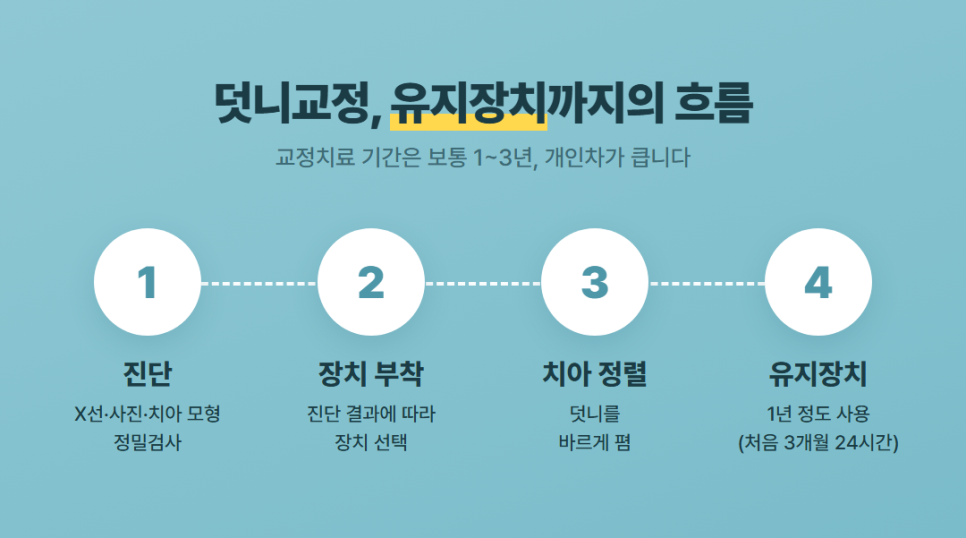
Orthodontic treatment typically takes about 1 to 3 years, though this varies significantly from person to person.
It also depends on whether extraction is involved, so an exact timeline can only be given after a diagnosis.
Because orthodontic treatment isn’t covered by national health insurance, costs vary between clinics.
They also depend on the severity of the crowding and the type of appliance used, so the most accurate figure comes after an exam.
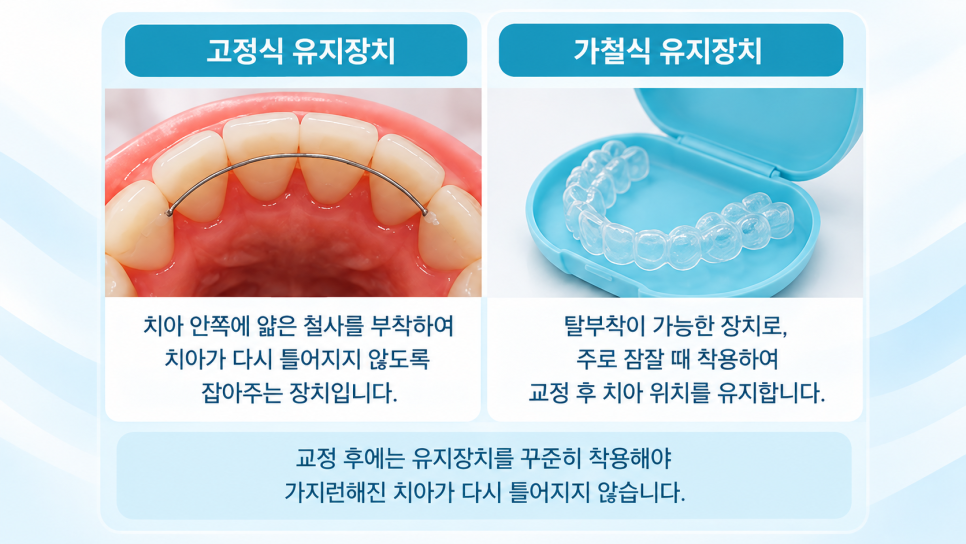
After treatment ends, teeth tend to drift back toward their original position.
That’s why a retainer is typically worn for about a year to help reduce relapse.
· During orthodontic treatment, side effects such as gum recession, root resorption, or decalcification (white spots on the tooth surface) can occur.
· It’s best to discuss these possible side effects during the consultation before treatment begins.
What Should You Check Before a Consultation in Cheongnyangni?
Check whether the clinic explains the reasoning behind its extraction or non-extraction decision for crooked canine tooth correction based on a thorough exam.
If you’re looking for an orthodontic clinic around Cheongnyangni, Dongdaemun, or Yongdu-dong/Jeonnong-dong, here are three things worth checking.
✅ Is the treatment provided by an orthodontic specialist? (You can verify this by region and name on the Korean Association of Orthodontists website)
✅ Does the clinic perform a thorough exam, including X-rays, facial photos, and a dental model (intraoral scan)?
✅ Does it explain the reasoning behind the extraction decision and appliance choice based on your specific tooth condition?
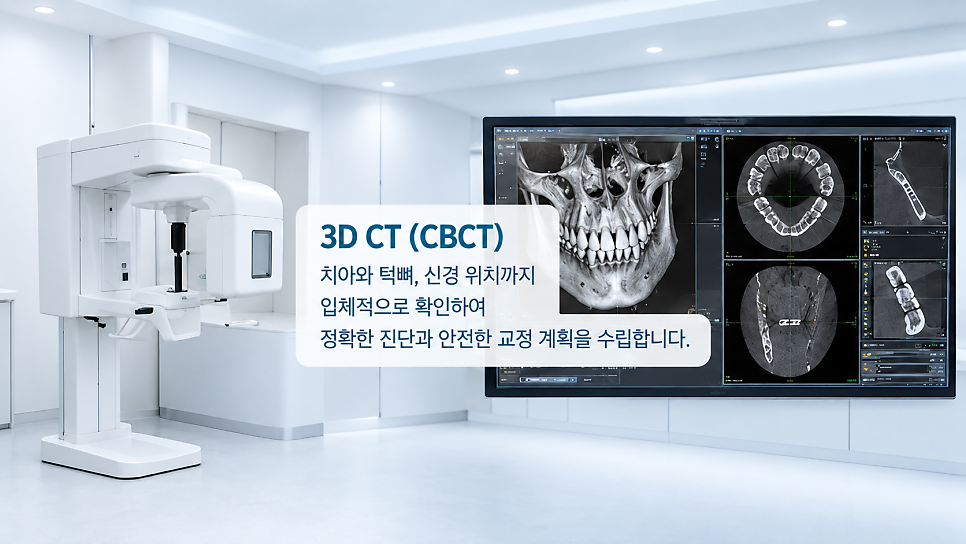
Yonsei Dajeonghan Orthodontic Dental Clinic, near Cheongnyangni Station in Dongdaemun-gu, Seoul, has orthodontic and integrated dentistry specialists who diagnose using 3D CT and 3D scanners.
If you need an orthodontic consultation, you can find more information at the Yonsei Dajeonghan Orthodontic Dental Clinic website.
Frequently Asked Questions
1. Can adults get treatment for a crooked canine tooth, too?
Yes. There’s no age limit for orthodontic treatment.
That said, tooth movement is slower in adults and relapse is more likely, so gum and cavity health are checked first.
2. When should a child’s crooked canine tooth first be checked?
The Korean Association of Orthodontists recommends an orthodontic consultation around age 7, when the front teeth are replaced by permanent ones.
In growing children, teeth tend to move more easily, which lowers the risk of relapse.
3. Can the first consultation for crooked canine teeth in Cheongnyangni tell you right away whether extraction is needed?
The first consultation mainly determines whether treatment is needed at all.
Whether extraction is required is decided based on a thorough exam — X-rays, photos, and dental models — and the diagnosis can sometimes take more than a week.
4. Do teeth become loose when a crooked canine tooth is corrected without extraction?
Non-extraction methods like arch expansion, interproximal reduction (IPR), and molar distalization are designed to create space only within the range the teeth and gums can tolerate.
Still, whether this approach applies to you must be confirmed through a thorough exam.
References
· Korean Association of Orthodontists, “When to Start Orthodontic Treatment,” official KAO website. Link
· Jiang Y, et al., “Duration of orthodontic treatment with clear aligners versus fixed appliances in crowding cases: a systematic review,” Clinical Oral Investigations, 2024. Link
· Bae Gi-seon, “Clinical Limitations of Clear Aligners and Their Solutions,” Journal of the Korean Dental Association 54(7), 2016. Link
This article is intended for general health information purposes only and is not a substitute for individual diagnosis or treatment. If you have symptoms, please consult a specialist.